How to Play Calcudoku: Rules, Tips & Strategies
Calcudoku is a fun and rewarding math logic puzzle that combines arithmetic with logical thinking and deduction. Similar to the popular KenKen® puzzle format, Calcudoku challenges you to fill each grid while solving addition, subtraction, multiplication, and division cages. For more ideas, see our printables and Calcudoku puzzles.
How to Play Calcudoku: Rules, Tips & Strategies
Calcudoku is a number puzzle that combines logic with basic arithmetic. Similar to the popular KenKen® puzzle format, each puzzle is divided into groups of cells called cages. Your goal is to fill the grid with numbers while following the row, column, and cage rules.
Calcudoku Rules
The rules are simple, but every rule must be satisfied for the puzzle to be solved correctly.
1. Fill Every Square
Each square in the grid must contain one number.
The numbers you can use depend on the size of the puzzle:
- A 4×4 Calcudoku puzzle uses the numbers 1 through 4.
- A 5×5 Calcudoku puzzle uses the numbers 1 through 5.
- A 6×6 Calcudoku puzzle uses the numbers 1 through 6.
2. Do Not Repeat Numbers in a Row
Each number may appear only once in every row.
For example, a 4×4 puzzle must contain the numbers 1, 2, 3, and 4 exactly once in each row.
3. Do Not Repeat Numbers in a Column
Each number may also appear only once in every column.
This means every row and every column of a completed 4×4 puzzle will contain the numbers 1, 2, 3, and 4 in some order.
Understanding Calcudoku Cages
The grid is divided into outlined groups of squares called cages. Each cage contains a target number and usually an arithmetic symbol.
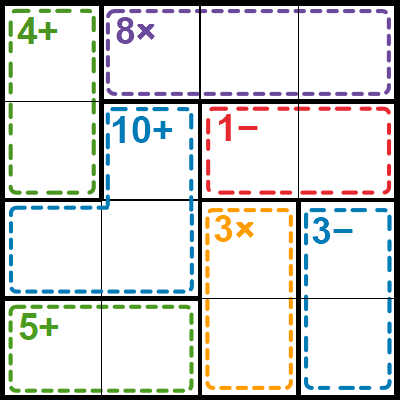
The 4×4 example above uses colored dashed lines to make the individual cages easier to identify. Each row and column must contain the numbers 1, 2, 3, and 4 exactly once. The cage clues provide the arithmetic information needed to determine where those numbers belong.
The number and arithmetic symbol in each cage tell you what the numbers inside that cage must equal.
- 4+ means the numbers in the cage must add up to 4.
- 8× means the numbers in the cage must multiply to equal 8.
- 1− means the difference between the two numbers must equal 1.
- 3− means the difference between the two numbers must equal 3.
- 2÷ means one number divided by the other must equal 2.
Solving the 4×4 Example
Let’s use the puzzle above to see how the cage clues and row-and-column rules work together.
Start With the 3− Cage
The blue 3− cage on the right contains two squares. Because a 4×4 puzzle uses only the numbers 1 through 4, there is only one pair with a difference of 3: 1 and 4. We do not yet know which square contains the 1 and which contains the 4, but we have reduced the possibilities to a single pair.
Look at the 3× Cage
The orange 3× cage also contains two squares. The only two numbers from 1 through 4 that multiply to 3 are 1 and 3. Again, the cage tells us which numbers must be used even if their exact positions are not immediately known.
Use the 5+ Cage
The green 5+ cage at the bottom contains two squares. Two possible pairs add to 5: 1 + 4 and 2 + 3. The cage clue alone is not enough to choose between them, so we use information from the other cages and the row and column rules.
Solve the 8× Cage
The purple 8× cage spans three squares in the top row. Those three numbers must multiply to 8. Since numbers cannot repeat in the same row, the numbers must be 1, 2, and 4. That means the remaining square in the top row must be 3.
Use the 4+ Cage
The green 4+ cage contains the top two squares in the first column. We just determined that the top square is 3, so the square directly below it must be 1, because 3 + 1 = 4.
Continue With Elimination
Now the row and column restrictions begin to narrow the remaining possibilities. The blue 10+ cage must total 10, the red 1− cage must contain two numbers with a difference of 1, and the values already determined prevent duplicate numbers from appearing in a row or column.
Continuing this process solves the puzzle as follows:
| 3 | 1 | 4 | 2 |
| 1 | 4 | 2 | 3 |
| 4 | 2 | 3 | 1 |
| 2 | 3 | 1 | 4 |
Notice that every row and column contains 1, 2, 3, and 4 exactly once, while every cage also satisfies its target. This is the key to solving Calcudoku: use the arithmetic clues to narrow the possibilities, then use row and column logic to determine the exact placement of each number.
Addition Cages
An addition cage uses the + symbol. If a two-square cage is labeled 5+, possible combinations in a 4×4 puzzle include 1 + 4 = 5 or 2 + 3 = 5.
The row and column rules help determine which combination belongs in the cage and where each number should be placed.
Multiplication Cages
A multiplication cage uses the × symbol. For example, a cage labeled 8× might contain 2 × 4 = 8.
A larger cage can contain three or more numbers. You multiply all of the numbers in the cage to reach the target.
Subtraction Cages
Subtraction cages normally contain two squares. For a cage labeled 3−, the two numbers must have a difference of 3.
In a 4×4 puzzle, the combination would therefore be 4 and 1. The order does not matter.
Division Cages
Division cages also normally contain two squares. For a cage labeled 2÷, possible combinations in a 4×4 puzzle include 2 and 1 or 4 and 2.
One number divided by the other must equal the target number. Again, the row and column rules determine which combination works.
Single-Square Cages
Some Calcudoku puzzles include a cage containing just one square. A single-square cage does not need an arithmetic operation. The target number tells you exactly which number belongs in that square.
For example, a single square labeled 3 must contain the number 3. These cages are especially helpful when beginning a puzzle because they provide an immediate starting point.
How to Solve a Calcudoku Puzzle
There is no single required order for solving Calcudoku. The best approach is to look for cages with the fewest possible number combinations and gradually use those answers to eliminate possibilities elsewhere.
Start With the Easiest Cages
Look first for:
- Single-square cages
- Cages with only one possible combination
- Large multiplication targets
- Large or small addition totals
- Subtraction cages with limited possibilities
- Division cages with limited possibilities
These cages often provide the quickest clues.
Use the Row and Column Rules
Do not solve cages independently. Suppose you determine that a cage must contain 1 and 4. You may not immediately know which square contains the 1 and which contains the 4.
Look at the other numbers already placed in those rows and columns. If one row already contains a 4, that square cannot contain another 4. Therefore, it must contain the 1.
This process of elimination is one of the most important Calcudoku solving techniques.
Look for Number Combinations
Learning common combinations can make puzzles much easier. For example, in a 4×4 puzzle:
- 8× is likely 2 × 4.
- 12× is likely 3 × 4.
- 7+ in two cells must be 3 + 4.
- 2÷ could be 2 and 1 or 4 and 2.
You still need the row and column rules to determine the exact placement of the numbers.
Pencil In Possibilities
For more difficult puzzles, consider writing small possible numbers inside empty squares. For example, if a square can only contain a 2 or 4, make a small note: 2, 4.
As other squares are solved, one possibility may eventually be eliminated.
Recheck Rows and Columns Frequently
Every time you place a number, check its entire row and column. One answer can often create another answer elsewhere in the puzzle.
For example, if a row already contains 1, 2, and 4, the remaining square must contain 3. Even if you have not completely solved that square’s cage, the row rule provides the answer.
Calcudoku Solving Tips
A few simple strategies can make solving Calcudoku faster and more enjoyable.
Work From Most Restrictive to Least Restrictive
Solve cages with very few possible combinations before working on cages that could contain many combinations.
A two-cell 12× cage in a 4×4 puzzle is much more restrictive than a three-cell 6+ cage.
Remember the Grid Size
Numbers larger than the grid size cannot be used. For example, a 5×5 Calcudoku puzzle only uses 1, 2, 3, 4, and 5.
The number 6 can never appear in a square, even when the target number of a cage is much larger.
Watch for Repeated Numbers
Numbers cannot repeat within the same row or column. They can, however, appear more than once within a cage if those squares are located in different rows and different columns and the puzzle allows that combination.
Use Arithmetic and Logic Together
Do not try to solve Calcudoku using arithmetic alone. The cage tells you which number combinations are possible, while the rows and columns tell you where those numbers can go.
The puzzle is solved by combining both types of information.
Common Calcudoku Mistakes
One common mistake is finding a number combination that satisfies a cage but accidentally repeating a number in the same row or column.
Another is assuming that subtraction and division must be performed in a particular direction. For a 2÷ cage containing 4 and 2, the cage is valid because the larger number divided by the smaller number equals 2.
Also remember that the target number applies to the entire cage, not to each individual square.
Which Calcudoku Size Should You Start With?
If you are new to Calcudoku, start with a 4×4 puzzle. The smaller grid has fewer possible numbers and makes it easier to learn how cages interact with rows and columns.
Once you are comfortable solving 4×4 puzzles, move on to 5×5 Calcudoku puzzles for a moderate challenge.
For more advanced practice, try 6×6 Calcudoku puzzles, which provide more possible number combinations and generally require additional deduction.
Practice Calcudoku
The best way to learn Calcudoku is to solve a few puzzles yourself. Start with an easy puzzle and work through the cages one at a time.
Explore our printable Calcudoku puzzles to choose from different grid sizes and difficulty levels, or use our Calcudoku Puzzle Generator to create a new puzzle whenever you want.
With a little practice, you will begin recognizing common number combinations and solving cages much more quickly.
Remember the three basic rules:
- Use every number once in each row.
- Use every number once in each column.
- Make every cage equal its target number.
Then use arithmetic, elimination, and logic to solve the puzzle.
Love Calcudoku? Save this idea!